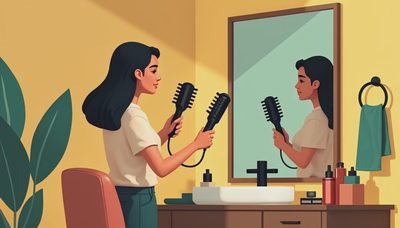
If you searched for a brush hot brush because you want smoother hair without juggling a round brush and blow dryer, I understand the appeal. On a normal workday, there is no spare half hour for a salon-style blowout. There is coffee to make, a child to find a shoe for, and a calendar that starts before your hair is fully dry. A heated brush can simplify that routine, but only if you choose the right format and use it on mostly dry hair.
The phrase brush hot brush usually refers to one of two tools: a heated styling brush that smooths dry hair, or a blow-dry brush that combines airflow and heat. They look similar online, but they behave differently. Knowing which one you need is the first way to avoid wasting $40 to $100 on a tool that sits in a drawer.
Decide which type fits your morning
A heated smoothing brush has solid bristles or comb-like teeth and runs through dry hair. It reduces puffiness, softens bends, and makes second-day hair look more intentional. It is generally the faster option for someone who already washed and dried her hair the night before. Brands such as GHD, Drybar, Revlon, and Amika sell versions with different heat settings and brush shapes.
A blow-dry brush uses airflow while you style damp hair. The Revlon One-Step Volumizer is the familiar example, while tools from Shark, Dyson, and T3 offer more controlled designs at higher prices. These brushes can create volume and a rounded finish, but they also require sections, tension, and enough time for hair to dry. If you have ten minutes before a video meeting, a blow-dry brush is not automatically the practical choice.
For fine, straight, or lightly wavy hair, a heated smoothing brush can be enough. Thick, coarse, or very wet hair usually needs a regular dryer first. No brush hot brush can safely replace the entire drying process when your hair is dripping.
What to check before buying
Start with temperature control. A tool with one very hot setting is difficult to adapt to fine hair, color-treated ends, or a quick touch-up around the face. Look for at least two or three heat levels and a clear display or indicator. More heat does not mean a better finish; it often means more risk of dryness and rough ends.
Next, examine the bristles. Closely spaced bristles provide more smoothing, while wider spacing moves through thick hair more easily. Short bristles may struggle with dense hair, and very firm teeth can catch at tangles. A brush should glide after you detangle, not force you to yank through knots. A cool tip and an insulated outer edge are useful when you are rushing near your ears and forehead.
Cord length, weight, and shutoff matter more than flashy packaging. A heavy tool becomes annoying halfway through a full head of hair. Automatic shutoff is a practical safety feature for mornings when you leave home thinking about daycare drop-off instead of the bathroom outlet. A swivel cord also helps if you style the back of your head without twisting your wrist.
How to use a heated brush without frizz
Begin with completely dry hair unless the product specifically says it is designed for damp styling. Apply a heat protectant, let it dry for a moment, and remove tangles with an ordinary brush. Divide your hair into two or four sections. Smaller sections produce a smoother result, but they do not need to be salon-perfect.
Place the brush under a section near the roots, pause briefly, and pull toward the ends at a steady pace. Do not repeatedly drag over the same strand. For the front pieces, direct the brush away from your face. On the ends, turn your wrist slightly inward if you want a soft bend rather than a poker-straight finish. The goal is controlled polish, not a helmet of hair.
A brush hot brush works best when you match the temperature to the job. Use a lower setting for bangs, face-framing pieces, and fine ends. Use a moderate setting for thicker sections, but make one slow pass before deciding you need more heat. If your hair smells burnt, feels brittle, or becomes static-filled, stop and reduce the temperature.
The office-day test
Bathroom lighting can make almost any style look finished. Fluorescent office lighting is less forgiving. A successful tool should leave hair smooth but still movable, with no obvious flat patches at the crown and no fluffy halo by lunchtime. I would rather see a polished bend around the face than exaggerated volume that collapses before the first meeting.
For a standard Tuesday, style the front and top first. Those are the areas people see during a conversation or video call. If time is limited, smooth the sides and leave the underneath natural rather than trying to perfect every strand. A five-minute pass can make a ponytail, claw clip, or low bun look deliberate.
The brush hot brush should also fit your afternoon plans. If you commute by train, walk outside, or pick up children after work, humidity and movement will affect the result. A light smoothing cream on the ends can help, but avoid loading the roots with oil. Clean the bristles regularly because dry shampoo, hairspray, and scalp oils reduce glide.

Common buying mistakes
The first mistake is expecting instant salon volume. A smoothing brush usually creates a straighter, neater finish; it does not automatically create bouncy round-brush lift. For volume, start at the roots and hold the brush upward for a few seconds, or choose a blow-dry model with airflow and a rounded barrel.
The second mistake is buying based only on the highest temperature. A $30 tool with limited control may work for one hair type and frustrate everyone else. Spending $60 to $150 can make sense when the tool has better heat regulation, a comfortable handle, and a shape that matches your density. Price alone, however, does not guarantee a better weekday result.
The third mistake is using it on wet hair when the instructions do not allow it. That slows styling and can expose hair to unnecessary heat. Dry your roots and lengths first, then use the tool for finishing. This simple change often saves more time than purchasing a more expensive model.
A practical recommendation for working women
If your priority is speed, look for a lightweight heated smoothing brush with adjustable heat, insulated bristles, automatic shutoff, and a long swivel cord. Choose a blow-dry brush only if you regularly style damp hair and can give it at least fifteen minutes. The right tool should make your routine shorter, not create another complicated step.
Before purchasing, check the return policy and confirm whether replacement parts or warranty support are available. Read reviews for comments about fine hair, thick hair, frizz, and actual weight rather than only glossy descriptions. A tool that looks beautiful on a bathroom counter is not necessarily useful at 8:15 a.m.
My final test is simple: can I use the brush hot brush on an ordinary morning, with imperfect sectioning and limited time, and still look polished under office lights? If yes, it has earned drawer space. If it requires perfect technique, wet hair, three styling products, and a quiet house, pretty in theory does not count. If it can't survive a Tuesday, it's not worth it.