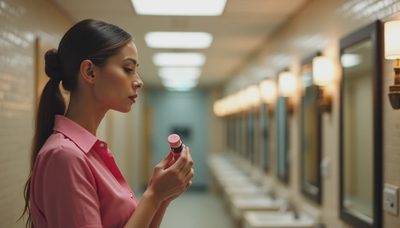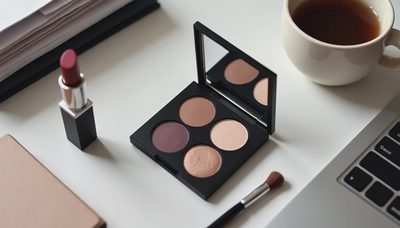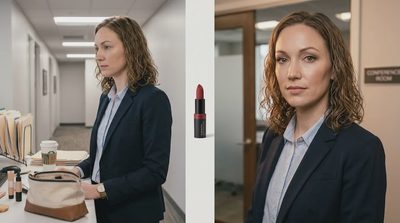
After six years of hiring interviews, back-to-back meetings, and school pickup lines in Charlotte, I've stopped asking whether a lipstick shade is pretty and started asking whether it works. That distinction matters. Finding office appropriate lipstick shades is less about following rules and more about running a repeatable test, because a color that looks lovely in your bathroom mirror can turn patchy, orange, or loud under the conditions of an actual workday — the fluorescent conference room, the laptop camera, the second coffee, the 12:45 salad.
So here is my lipstick test. It has four gates, and a shade has to pass all of them before it earns a spot in the bag I actually carry to the office. I run every new color through it on a normal Tuesday, because Tuesdays are honest. If it can't survive a Tuesday, it's not worth it.
The Lipstick Test: Four Gates Every Shade Has to Pass
The test is simple, and you can run it yourself in one workday. Each gate eliminates a surprising number of shades that otherwise seem like safe picks.
Gate 1: The video call camera. I check my face on screen before a call with my webcam preview, not the bathroom mirror. Laptop cameras shift color, and shades with blue undertones often read darker and more formal than intended, while anything too pale can wash out entirely.
Gate 2: The fluorescent conference room. Our main meeting room has overhead fluorescent lighting that flatters nobody. It exaggerates shimmer, magnifies every lip line, and pulls pink shades either mauve or orange depending on your skin tone.
Gate 3: The coffee cup. By mid-morning I'm on my second coffee. A shade that leaves a full rim print on a white paper cup is a shade I have to babysit all day, and I don't have time to babysit lipstick between interviews.
Gate 4: The post-lunch check. After a salad, a sandwich, or whatever Ella left on my plate, I look in the car mirror before walking back in. A good shade fades evenly into a soft stain. A bad one clings to the inside of my lips and leaves a ring that reads as careless in a 2 p.m. presentation.
My rule for the whole routine — the same one I lean on for all my everyday makeup for professional women decisions — is that the product has to keep working while I'm paying attention to something else. Lipstick should not require monitoring.
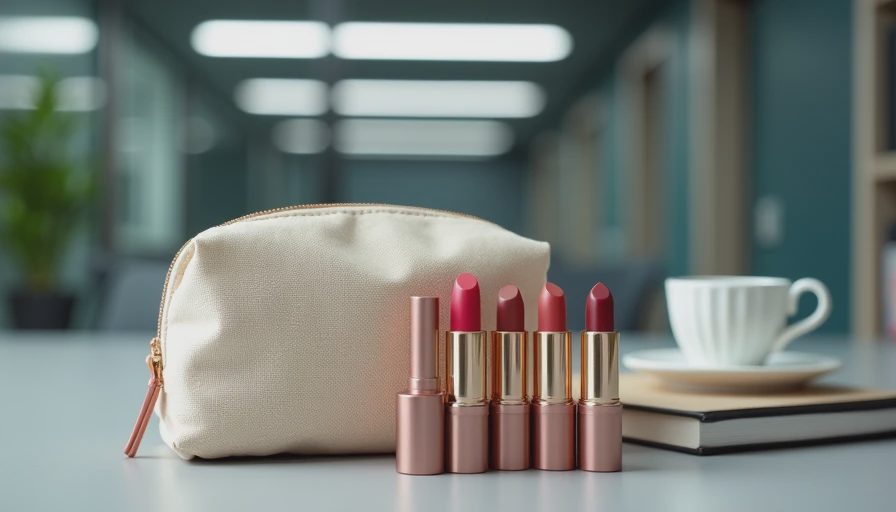
The Shade Families That Pass (and the Ones That Flunk)
Here is the pattern I've noticed after testing more colors than I'd like to admit: the shades that pass are the ones that sit close to a slightly amplified version of your own lip color. The ones that fail are the ones fighting your lip color instead of building on it.
Shade family | Video call camera | Fluorescent room | Coffee cup | After lunch |
|---|---|---|---|---|
Muted rose | Reads natural, slightly polished | Stays true, no weird cast | Light transfer, even fade | Soft even stain |
Warm nude | Balanced on camera | Can wash out if too pale | Minimal transfer | Fades evenly if satin |
Soft berry | Adds healthy color without drama | Holds up, reads professional | Moderate transfer | Pretty stain, easy reapply |
Brick | Warm and polished on screen | Stays warm, no blue shift | Moderate transfer | Even fade |
High-pigment blue-red | Reads heavier and more formal on camera | Can turn harsh or theatrical | Heavy rim print | Uneven ring, needs full redo |
Flat matte nude | Emphasizes lip lines on camera | Magnifies every texture | Fine | Clings and cracks, patchy |
High-shine gloss | Blows out white on camera | Glare under fluorescents | Sticky, drags color off | Gone entirely |
A few notes on the winners. Muted rose is the shade family I recommend to anyone who wants one reliable tube, because it works across skin tones and reads as "put together" rather than "made up." Brick — that warm, brown-leaning red — is my personal favorite for presentation days, because it has presence without the severity of a true red. Soft berry carries a boardroom day when I want to look more decisive, and a satin-finish soft berry passes the after-lunch gate better than almost anything else. If you want a short list, these are the office appropriate lipstick shades I would buy first: a muted rose satin and a brick.
The losers fail for predictable reasons. A saturated blue-based red isn't unprofessional — it's just high-maintenance, and under our conference room lights it can look like evening makeup at 10 a.m. A flat matte nude sounds like the safe corporate choice, but matte formulas settle into lip lines, and the camera makes the texture worse, not better. Gloss feels fun on a Saturday brunch in South End with David and the kids, but it photographs as glare and slides off by the second meeting.
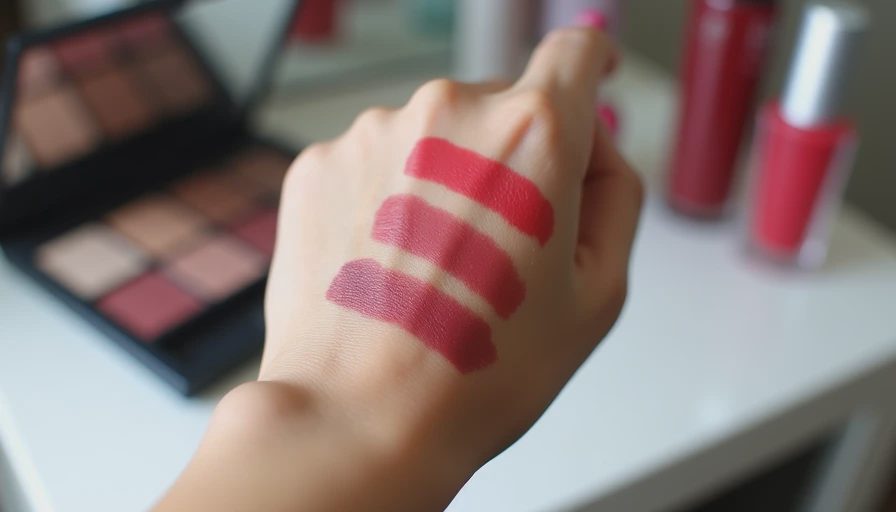
Why Satin Finish Is the Safe Zone
Finish matters as much as color, and satin wins on every gate. Here's the logic: satin has enough slip to not emphasize lip lines, enough pigment to leave a stain as it fades, and a soft sheen that reads as "healthy lips" on camera instead of "texture problem." It's the finish I trust for the full arc of a workday — 8 a.m. drop-off at Ella's school, meetings through the morning, lunch, and the drive to Cole's daycare before the commute home.
That doesn't mean you have to abandon matte entirely. If you love a matte shade, there's a workaround that has served me well.
What to Do When You Love a Matte Anyway
Blot it down. Apply the matte shade, press your lips together on a tissue, then tap a tiny bit of lip balm over the top with your fingertip. You keep most of the color depth, you soften the flat texture that cameras punish, and you buy yourself an extra hour before it starts cracking. I do this with a brick matte on long meeting days, and it takes about fifteen seconds in the car.
The reverse trick also works when a shade fails Gate 3: a sheer satin formula in a similar tone layered over a stain lasts through coffee far better than a single heavy application. Two thin layers beat one thick one in every version of this test I've run.
An HR Manager's Honest Take on Lipstick and First Impressions
I want to be careful here, because I've sat on the other side of the table for six years and I've seen how small signals add up. Lipstick color will not make or break a career — competence does that. But a shade that looks intentional and maintained does contribute to an overall impression of being settled and detail-oriented, in the same way that a wrinkle-free blazer does. A shade that has clearly worn off into a ring, or a gloss that needs constant reapplying mid-conversation, pulls attention in a way that doesn't help you.
In practice, this means I keep two tubes in my work bag: the muted rose satin for ordinary days, and the brick for the days I'm leading a meeting or running an interview panel and want to feel a little more anchored. When you're the person asking the questions, a slightly deeper shade genuinely seems to help me feel put together, and that confidence is worth more than the color itself. My short list of office appropriate lipstick shades has stayed the same for three years. Pretty in theory does not count — whatever you wear has to hold up under fluorescent lights, a webcam, and a paper coffee cup, all before lunch.
One last practical note from someone who tests colors on the back of her hand in the Target beauty aisle most weekends: swatch on your lips, not your hand, whenever the store has a tester. Hand skin is a different tone and texture, and I have bought more than one "warm nude" that turned gray on my actual mouth. The test costs you two minutes. Replacing a tube that flunks Gate 1 costs a lot more.