I have been an HR manager at a mid-size financial services company in Charlotte for six years, which means I have interviewed a lot of people, run a lot of meetings, and fielded a lot of questions about office image. Here is the thing nobody tells you: when I say a candidate looked polished, I am not scoring their makeup technique. Professional makeup for women in a corporate setting has a very narrow job, and that job is to let your work lead the conversation. If your makeup draws questions, it is not polished. Polished is invisible competence, and it has almost nothing to do with how many products you own.
That took me a while to learn. I used to think "polished" meant more — more coverage, more blending, more time in the mirror. Then I spent years on the other side of the interview table, watching what actually reads as professional. Now I run everything through one test: would this survive a regular Tuesday? Fluorescent lights, dry office air, a 9 a.m. meeting, coffee, a walk to the parking deck, and pickup at daycare by 5:45. If a look works in a mirror at home but falls apart by lunch, it was never polished — it was just pretty in the bathroom light.
What "Polished" Really Means From Across the Desk
As an HR manager, I can tell you what polished means to me in three words: appropriate, tidy, and consistent. The order matters, and so does the definition.
Appropriate. Does the look fit the room? A client-facing meeting in a conference room asks for something quieter than a dinner out. I am not talking about rules — your company's dress code does that. I am talking about judgment. Candidates and employees who dress and do their makeup for the actual room look like they read the room. That is the fastest signal that they read people, too.
Tidy. Nothing smudged, nothing creased, nothing flaking. A mascara smudge at 2 p.m. tells me you didn't check a mirror after lunch. Small detail, sure. But in an office, small details are how the rest of us judge reliability before you get a chance to prove it.
Consistent. You do not look like one person at a morning interview and another person at the follow-up. Consistency is about repeatability. If the look only happens when you have a quiet hour to get ready, it will not survive a week of school drop-offs and early meetings.
Here is my HR filter for professional makeup for women: if a manager cannot describe your look two hours after meeting you, that is a win. People should remember what you said, not what was on your face. I have hired candidates whose makeup I could not describe at all, and I have passed on candidates whose makeup I could describe in detail. The second group usually did not mean to distract anyone, but they did — and in a room where attention is currency, that is a real cost.

What I Notice Under Fluorescent Light (and What I Do Not)
Office lighting is the enemy of everything we were taught in beauty tutorials. I learned this the hard way during my own first years in HR, sitting in windowless conference rooms where the lights buzzed and the colors shifted. Fluorescent light flattens skin, pulls out redness, and turns warm foundations orange. So here is my rule: never trust a makeup decision made in your bathroom. Check it in the office before you trust it.
The basics matter more than any trend. Three things carry most of the load: skin, brows, and lips.
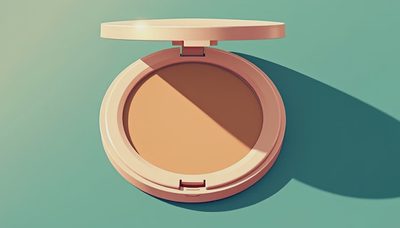
Skin does not need to be flawless; it needs to look like skin. Heavy coverage under fluorescent light reads as a mask, and masks read as hiding something. A light-to-medium base that lets your actual skin show through does more for credibility than a high-coverage foundation ever will.
Brows frame your face in meetings. Groomed, tidy, and slightly filled is the sweet spot. The people I interview are not scrutinizing your arches; they are subconsciously reading whether you take care of the details.
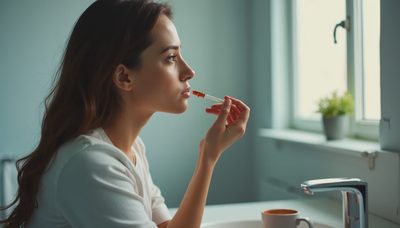
Lips need a color that works in daylight, not just in the store mirror. I keep a small range of muted, office-appropriate shades, and I test them at work, not at the counter.
The table below is the honest version of what I have watched help and hurt people in interviews, meetings, and everyday office life. I did not invent this — I watched it happen over years of sitting across a table.
Makeup That Works Against You | Makeup That Works For You |
|---|---|
Heavy foundation that looks like a mask under office lights | Light-to-medium base that lets skin texture show |
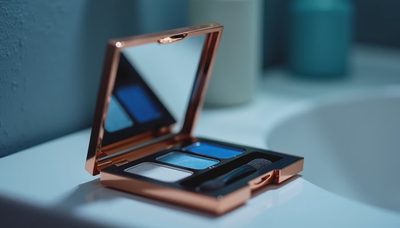
Bright or shimmery eyeshadow that catches light | Muted matte tones in the same family as your skin |
Glossy lip color that needs constant reapplication | Satiny or matte lip color that lasts through coffee |
Dramatic winged liner that smudges by noon | Simple liner that stays put or a mascara-only eye |
Anything that clashed with your outfit and changed how people looked at you | Everything neutral enough that nobody can remember it |
My personal rule comes from years of this: professional makeup for women in an office is not about looking more attractive. It is about looking like someone who manages her own details, because that is the person we trust with the details of other people's work.
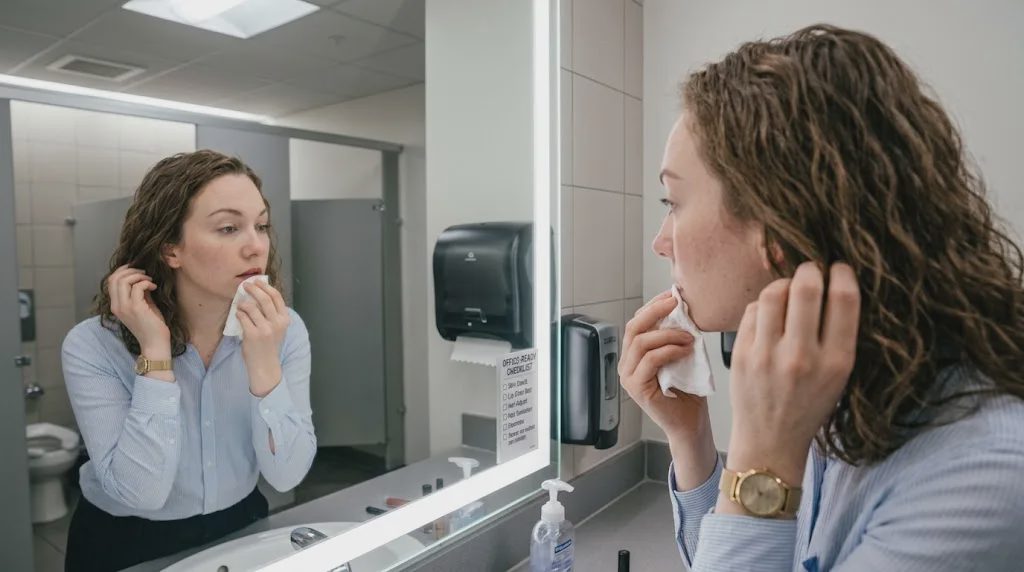
The Office-Ready Check I Run Before I Leave the House
I do not have time for an elaborate routine, and honestly neither do most people I work with. Professional makeup for women does not have to mean a long routine, and my office makeup routine is about twenty minutes on a good day. It starts with a list, built after too many mornings where I looked good at home and wrong by 9 a.m.
Fluorescent light check. After I finish my makeup, I walk into the brightest light in the house — usually the kitchen or the bathroom with the harsh overhead light — and look at my face head-on. If anything reads orange, chalky, or gray in that light, it will read the same way in the conference room. Fix it before you leave.
Color check. Do a quick honesty scan. Is anything on my face the loudest thing in the room? Bright lips, strong color in the eye area, or blush that shows up from across the table will all get noticed before your words do. Tone it down.
Complete-but-low-key check. Is my base even enough to look finished? Are my brows tidy, my lips on, and my mascara fresh? "Complete" means nothing is missing and nothing is loud. The goal is a face that looks cared-for without asking for attention.
This is where I live with a work makeup bag that I keep stocked and ready. After I drop Ella and Cole at school and preschool, I do not have a spare minute to hunt for a missing brush or a dried-out concealer. A bag with the same dependable basics — base, concealer, brow pencil, mascara, one neutral lip color — means I can get from zero to office-ready in one pass.
And one more honest note: oily skin under dry office heat and full sun in the parking deck is a normal Tuesday combination. Blotting papers and a setting mist in a desk drawer have saved more of my mornings than any fancy primer. Fix it with a product, not with more layers.
The Honest Connection Between Makeup and Credibility
I want to be straight with you about something uncomfortable: appearance does not deserve to matter, but it does. I have watched strong candidates lose points over a distracting look, and I have watched average candidates gain credibility just by looking like they had their morning under control. It is not fair, and it is not logical, but it is real. Knowing that does not make it right — it makes it useful.
The good news is that you do not need to become a makeup artist to handle it. You need a small set of dependable products, a routine you can repeat on the worst morning, and a mirror check under real office light. Nothing about that requires skill or expensive products. It requires consistency, which is exactly the quality the office is trying to evaluate anyway.
This is why I keep coming back to the same standard for myself and for the women I coach through office image questions: If it can't survive a Tuesday, it's not worth it. A Tuesday has fluorescent lights, dry air, a full meeting schedule, coffee on the go, and pickup duty. If your professional makeup for women checklist survives that, it will survive an interview, a presentation, or a bad week. If it only works on a slow Sunday, it was never going to work where it counted.
When I get ready for a normal workday now, I think about what David will see at dinner, what the kids will do to my jacket, and what my 9 a.m. will look like under those conference room lights. That keeps my perspective straight. A Saturday brunch in South End with friends gets a little more color. A Tuesday at the office gets the standard. That division has served me well through six years of hiring decisions, and it will keep serving me on the days when I am the one being evaluated.
Polished, in the end, is not a makeup style. It is a decision to remove friction. The less anyone has to think about how you look, the more they can think about what you said — and that, from an HR manager's desk in Charlotte, is what polished actually means.