I have spent six years as an HR manager in a Charlotte, North Carolina office building where the fluorescent panels hum directly over every desk, and I can tell you the single most important thing I have learned about concealer: the mirror in my bathroom lies. My bathroom lighting is warm, forgiving, and angled from the side. My office lighting is flat, blue-white, and angled from above, which means it highlights every single crease, every patch of dryness, and every shade of gray I did not know my under-eyes could produce. Finding the best concealer for office lighting is not about finding the most coverage in the store. It is about finding the one that still looks like skin after eight hours under panels that show no mercy. Pretty in theory does not count.
This piece is everything I have figured out through years of real trial and error — desk tested, coffee consumed, HVAC dryness endured, and one too many moments catching my reflection in the elevator before a 9 a.m. meeting with a candidate.
Why Fluorescent Light Punishes Your Under-Eyes
Fluorescent light is the problem, not your face. That is the first thing to understand. Those overhead panels emit a cool, diffuse light that erases shadows everywhere on your face except the places where texture already exists — and then it exaggerates them. A concealer that looks smooth at home can look like it is sitting in every single fine line under the office panels by 10 a.m.
Here is what fluorescent light specifically does to the under-eye area:
Amplifies texture. Any creasing or settling that would be invisible in warm lighting becomes a topographic map under cool fluorescent light.
Exposes gray tones. Concealers that oxidize or lean too pink will turn muddy and gray-ish, and fluorescent light makes that shift obvious instead of hiding it.
Flattens dimension. Because the light is so even, you lose the natural shading that makes faces look alive. Over-concealed under-eyes read as blank, almost mask-like.
Highlights dryness. My office HVAC runs year-round and dries the air like a desert. Any powder-heavy or matte product under fluorescent light looks chalky within hours.
I noticed this the hard way. I once did a full-coverage concealer morning — thick layer, set with a heavy powder — and walked into a panel interview feeling polished. Then I saw myself in the bathroom mirror afterward and realized I looked like I had aged ten years in two hours. Every line I did not know I had was suddenly a highlight reel.
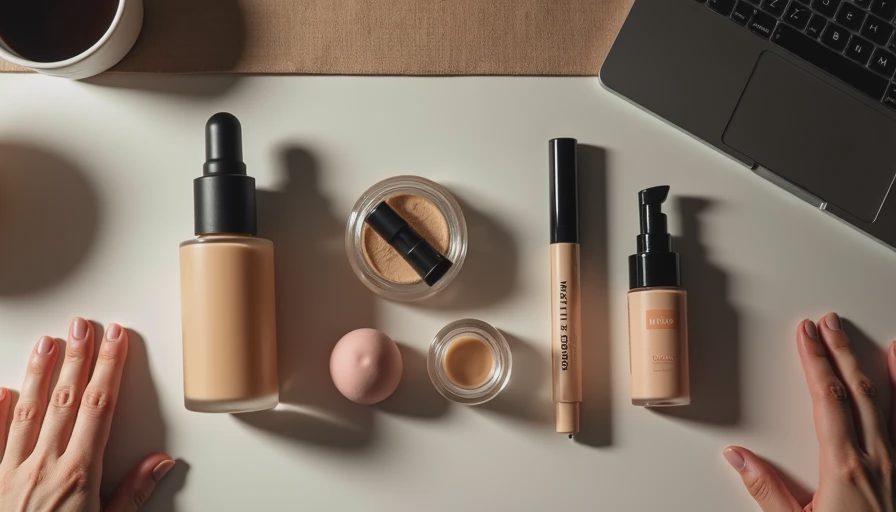
What Actually Survives: Texture and Application
A hydrating liquid concealer with a doe-foot applicator is the texture I keep coming back to for workdays, and here is why: thin, flexible formulas move with your skin instead of sitting on top of it. Thick, heavy cream concealers give you coverage on paper, but under fluorescent panels they crease into every line the moment you smile at a coworker in the hallway.
The comparison below reflects my experience across a lot of ordinary workweeks:
Texture | How It Looks Under Fluorescents at 8 a.m. | How It Looks by 3 p.m. | Notes |
|---|---|---|---|
Hydrating liquid (doe-foot) | Natural, skin-like | Still wearable, may need one touch-up | My default for meetings |
Cream in a pot | Full coverage, slightly heavy | Creases visibly in fine lines | Needs a very light hand |
Stick concealer | Decent, can look thick | Can go patchy on dry skin | Works better on blemishes than under-eyes |
Color corrector (peach-toned) under a thin liquid layer | Neutralizes darkness without layers of product | Holds up well | My trick for mornings after bad sleep |
Application matters as much as texture. I use the "thin layers, pressed in" method: one small dot of liquid concealer split between both eyes, pressed in with my ring finger — not dragged — and only add a second thin layer where I actually need it. Pressing instead of rubbing keeps the product on top of the skin instead of pushing it into lines. This is how you get makeup that lasts all workday instead of makeup that looks good for the walk from the parking deck and nothing after.
Two application mistakes I made for years:
Sweeping the doe-foot directly across the whole under-eye. One dot, then press, gives a more even result than dragging product back and forth, which pushes it into creases from the start.
Skipping moisturizer under concealer. In a dry, HVAC-heated office, eye cream first is non-negotiable. Concealer on dehydrated skin looks like paint within two hours, and no formula can fix that.
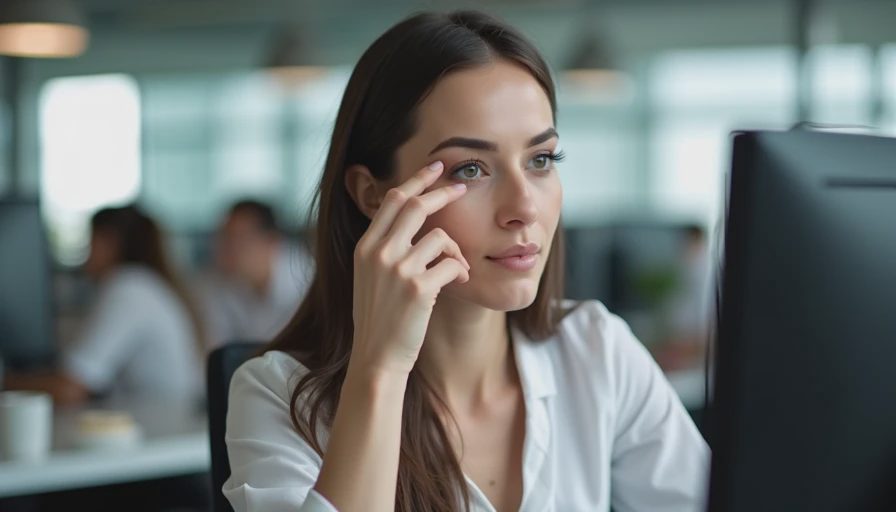
Shade Strategy: Brighten, Don't Mask
Go half a shade lighter, not two shades lighter. That is the whole shade strategy, and it took me an embarrassing number of Target runs to internalize. The old instinct is to go dramatically lighter under the eye to "lift" the area, but under fluorescent light, a shade that is too light looks like two pale crescents floating on your face. It reads as makeup, not as rest.
What works instead:
Half a shade lighter than your foundation. Enough to gently brighten the inner corner and the hollow, not enough to create an obvious halo.
A peach-toned color corrector first, when darkness is the main issue. One thin layer of corrector under a thin layer of concealer neutralizes blue-gray tones better than three layers of concealer alone, and with far less texture.
Skip the full-coverage goal entirely. Under fluorescent panels, a 70-to-80-percent correction of darkness looks fresher than a 100-percent mask, because the skin still shows through and the face stays dimensional.
When I compare the best concealer for office lighting, shade and texture come before coverage claims every time.
The Fluorescent Test: Check Before You Commit
Here is my simple two-step check, and I do this before I leave the house on any morning that matters — client calls, candidate interviews, presentation days.
First, check your concealer in the bathroom-style lighting, not your bedroom lamp. Second, take a phone front-camera photo with no filter, in whatever light you will actually be in. The front camera is brutal in a useful way: it flattens light the same way office panels do, and it will show you creasing and oxidation honestly.
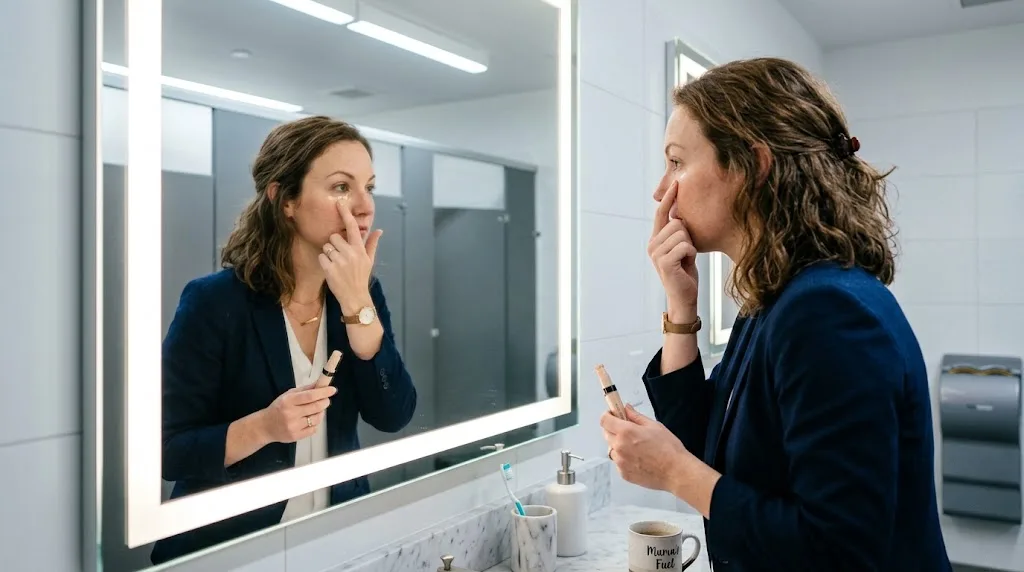
If you can, do the same check mid-morning at work — the office restroom mirror is the true final exam. If your under-eyes still look like skin at 10:30 a.m. in that mirror, the formula is a keeper. It is the same test I run on any claim about the best concealer for office lighting that I see online. If it can't survive a Tuesday, it's not worth it.
A quick note on setting: I set my under-eyes with the smallest possible amount of translucent powder, pressed on with a small puff only in the inner third where I get the most creasing. Skipping powder entirely on dry days and using the tiniest amount on humid Charlotte summer days is the balance that works for me.
What I Actually Do on a Normal Tuesday
On a realistic morning — David getting Ella's shoes on, Cole negotiating over which cereal, me with maybe ten minutes — my under-eye routine is four steps: eye cream, one dot of hydrating liquid concealer split between both eyes, pressed in with my ring finger, and a whisper of translucent powder in the inner corners. That is it. That routine has survived fluorescent panels, back-to-back interviews, a drive to preschool pickup, and a Saturday brunch in South End afterward without falling apart.
The lesson from years of desk testing is consistent: under fluorescent light, the concealer that wins is never the heaviest one. It is the one thin enough to behave like skin, in a shade close enough to your own to stay invisible, applied gently enough to stay out of your lines. That is good for real life, not just bathroom lighting.